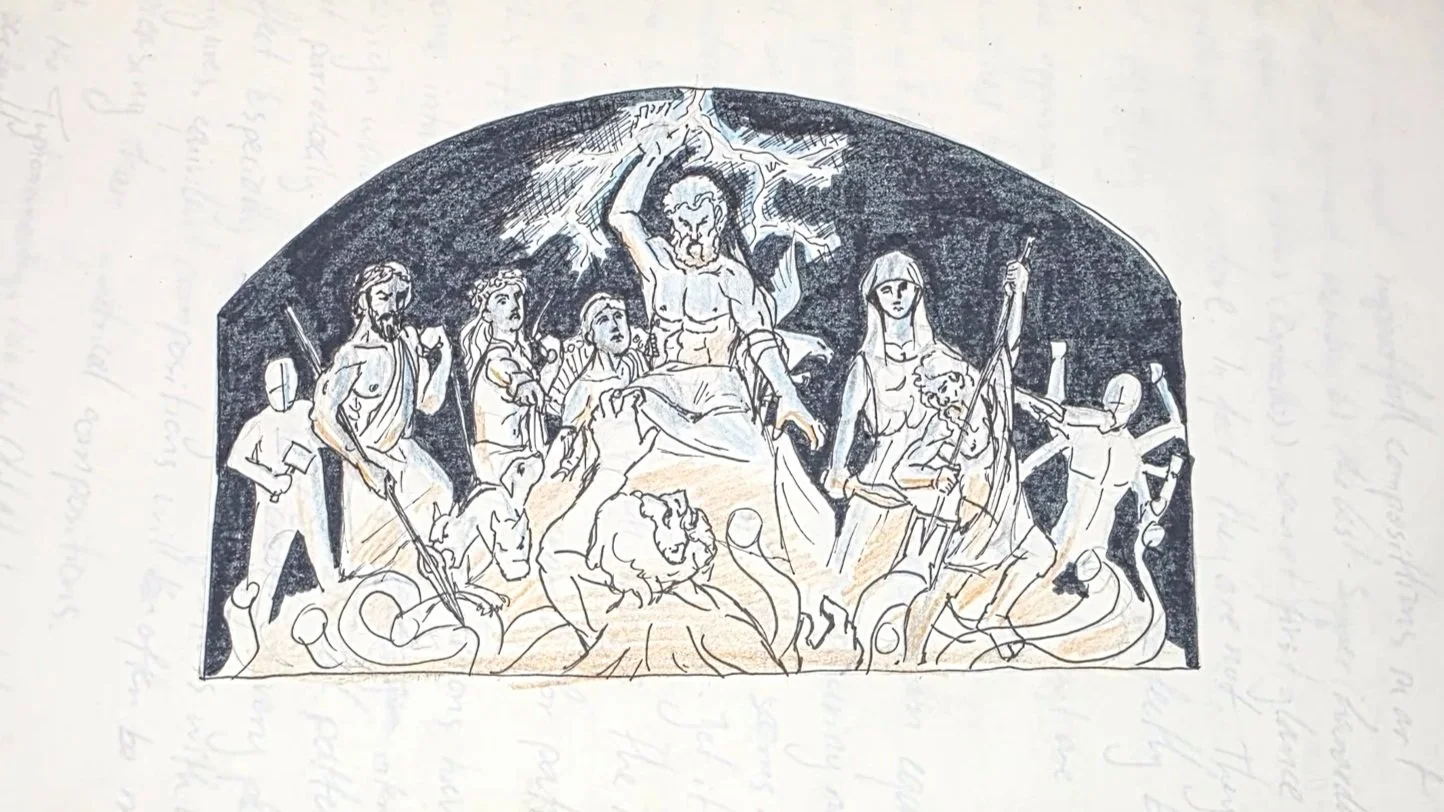
Composition… based on the golden ratio!
Perfectly balanced
Some of the most impactful compositions in art (The final judgement (Michelangelo), The last supper (Leonardo), The school of Athens (Raphaello)) seem at first glance to be symmetrical in nature. In fact they are not. They are not perfectly symmetrical, they are perfectly balanced. The opposing sides are not mirrored but they are carefully designed to be mirroring equivalencies. You will be hard pressed to find such an equivalent composition of figures in real life occurring naturally yet an equivalent composition in art just seems more ‘natural’ than a perfectly symmetrical one. Yet it retains the systematic patterning which pleases the mind. We humans are hardwired to search for patterns and this often pleases us. Equivalent compositions have the same intuitively sensed aura of intentional design which pleases us in symmetrical patterns, yet paradoxically seems more natural, creating compositons with human figures, equivalent compositions will often be more pleasing than symmetrical compositions.
In the Typhonomachy, like the Old Masters did, I aim to create a perfectly equivalent composition. This won’t quite work though as I have 6 Olympian Gods to put in the composition, yet I cannot put 3 Gods on each side of the centre line. The main focal point of the composition is Zeus & Typhon, meaning Zeus hás to be in the middle. So instead I’m grouping the Gods together in clusters of 2. Zeus & Hera in the centre, Hades and Demeter left and Poseidon and Hestia right. With Zeus taking precedence over Hera. A perfectly equivalent / balanced composition would have been far easier to create using 7 Gods, but the subject matter won’t allow this. I’ll try my best though to make the composition as balanced as possible, though balanced.
Pepijn, 2019
In the video Pepijn explains how he used a mathematical proportion that appears frequently in geometry, art and nature (‘de Gulden snede’ or ‘Golden Ratio’ ) to create a balanced composition.